What do we offer?
The Motorboat Helmsman by OAC International course is a comprehensive training program preparing participants for an internal examination certified by OAC International – Ocean Angels Certification. It is an international training program confirming competencies in international regulations related to operating vessels on inland and coastal waters.
The course program has been developed based on standards applied in European Union countries and selected countries around the world, taking into account the guidelines of international organizations such as RYA, ISSA, IYT, NauticEd and other maritime administrations. Thanks to this, participants gain reliable knowledge and practical skills that allow them to navigate safely and responsibly in waters around the world.
The training includes intensive practical and theoretical classes, including:
- maneuvering a vessel in port and open-water conditions,
- principles of international COLREG regulations,
- basics of meteorology and pilotage,
- safety and rescue procedures on the water.
Anyone who has reached the age of 14 may participate in the course.
The Motorboat Helmsman certificate issued by OAC International has a supplementary character – it does not authorize independent operation of vessels. It is valid only when used together with a license or certificate issued by the maritime or national administration of a given country.
Why training at Ocean Angels?
At Ocean Angels we focus on the highest quality of training, combining practice with modern learning methods. Our programs are created based on international standards and practices of organizations such as RYA, ISSA, IYT, ASA, RFEV, US Sailing, NauticEd, RYFB, TYF and DMYV, as well as according to the guidelines of UN Resolution 40 and ICC. We are one of the few organizations in Europe that offers a full OAC International internal certification process – from training, through examination, to issuing the document confirming competencies.
Every course at Ocean Angels combines:
- intensive practice on the water (up to 20 training hours),
- access to an e-learning platform with theoretical materials,
- an individual approach and real exercises in port and coastal conditions,
- full cost transparency – the price includes all fees,
- including certificate issuance and training materials.
After completing the training participants receive:
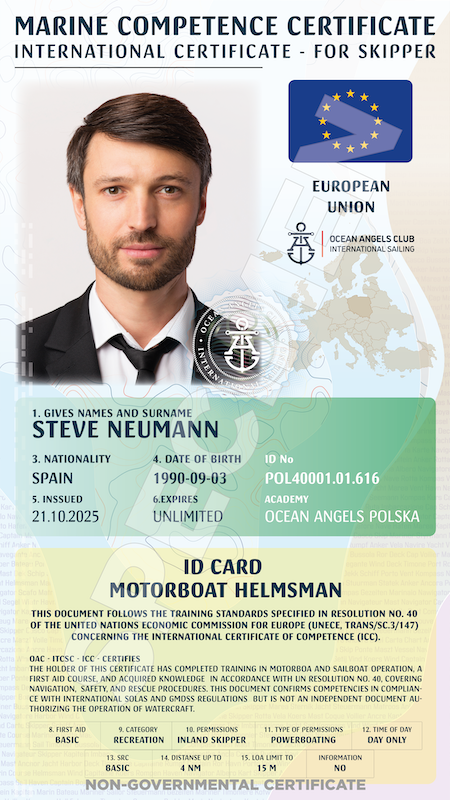
- OAC International Motorboat Helmsman certificate – issued exclusively in electronic form,
- certificate of training completion in accordance with international standards – in English,
- first aid certificate compliant with the European Resuscitation Council guidelines – in English,
- 12-month membership confirmed by an Ocean Angels certificate and a membership ID card (issued on request).
What are the differences between the documents?
The OAC International Motorboat Helmsman certificate differs significantly from national motorboat licenses. It is an international document recognized in many countries around the world confirming real practical skills and theoretical knowledge in the field of international regulations, safety and navigation.
The Ocean Angels training methodology has been individually developed based on the best standards and experience of European and international governmental and non-governmental organizations. It combines elements of the methodologies of RYA (Royal Yachting Association), ISSA (International Sailing Schools Association), IYT (International Yacht Training), NauticEd (international competency certification), ASA (American Sailing Association) as well as national administrations including maritime authorities, creating a coherent international certification system.
Unlike many local courses, OAC International trainings focus on practical skills, real maneuver scenarios and working in conditions close to real ones. Each certificate confirms knowledge consistent with the requirements of UN Resolution 40 and ICC, making it recognizable and respected within the international sailing community.
However, it should be emphasized that the OAC International certificate is not a document authorizing independent operation of vessels. It is a supplementary document confirming sailing competencies and qualifications in international maritime knowledge and should be used together with an appropriate license issued by a national authority. This document has the same level of recognition as certificates of other non-governmental organizations worldwide that do not have administrative authority to issue national licenses. It confirms completion of training in international maritime regulations and competencies at an international level.
What do the classes look like?
Theory in the classroom
1. Introduction and legal regulations,
2. Boat construction, engine and propulsion,
3. Pilotage and navigation marks,
4. Meteorology,
5. Communication and radio procedures,
6. Practice – maneuver planning,
7. Safety and basics of first aid
Practice on the lake
1. Boat operation and preparation,
2. Seamanship work,
3. Port maneuvers,
4. Navigation on open water,
5. Man overboard maneuver,
6. Mooring and anchoring approaches,
7. Pre-exam maneuvers
Course types and process
THE COURSE CAN TAKE PLACE IN TWO VARIANTS – YOU CHOOSE WHICH ONE
Hybrid Form
Step one:
After creating an account in our system and selecting the training, each candidate is required to complete the documents required by Ocean Angels.
Step two:
Each candidate must attend a series of three 2-hour online meetings with an OAC instructor.
Step three:
Participation in the e-learning training after the online meetings with the instructor.
Step four:
Completion of a knowledge verification test followed by registration for on-site training.
Step five:
Completion of on-site training allows the candidate to take the exam depending on the selected certification.
Step six:
Depending on the selected organization or license, the participant submits an application or awaits the relevant certification document.
On-site Form
Step one: Creating an account and completing required documents.
Step two: Optional 30-minute online preparation meeting.
Step three: 24-hour on-site training divided into theoretical and practical modules.
Step four: Participation in the exam depending on certification type.
Step five: Waiting for the issued certificate or license.